
Table of Contents
- Why Wooden Structures in Strata Schemes Face Higher Termite Risk
- AS 3660 Termite Management Compliance Explained
- Physical vs Chemical Termite Barriers for Wooden Structures
- Strata Termite Inspection Frequency: How Often Is Enough?
- Termite Detection Dog Accuracy in Large Strata Complexes
- Strata Bylaws, Liability and Budgeting for Long-Term Termite Management
- Conclusion: Building a Termite Protection Plan for Your Strata Scheme
- Frequently Asked Questions
Last Updated: September 28, 2026
Why Wooden Structures in Strata Schemes Face Higher Termite Risk
Strata schemes pack more timber into a smaller footprint than almost any other building type, and share walls, slabs and roof voids that let subterranean termites move between lots undetected. That makes termite protection strata management a structural obligation, not a landscaping afterthought.
The risk factors that matter most:
- Shared slabs and party walls give termites uninterrupted travel between lots
- Weep holes and slab edges sit at the exact entry point termites target
- Landscaped gardens and retaining walls against the building line hold moisture
- Roof voids and subfloors stay uninspected for years because no single owner is responsible
AS 3660 Termite Management Compliance Explained
AS 3660 is the Australian Standard for how termite management systems are designed, installed and maintained. It is a series, and the applicable part depends on whether you are dealing with a new build, an addition, or an existing building. Compliance is measured across the whole building, not individual units, the point most strata committees miss.
What AS 3660 Requires for New and Existing Buildings
For new construction, the standard requires a termite management system to be installed and a durable notice fixed to the building, identifying the system used, the installation date, and the maintenance and inspection requirements. It is a permanent fixture, not a sticker that can be painted over.
How AS 3660 Interacts with Strata Legislation
AS 3660 does not sit in isolation. Each state and territory has its own strata or body corporate legislation, the Strata Schemes Management Act in New South Wales, the Owners Corporations Act in Victoria, and equivalents elsewhere. These Acts set out what the owners corporation must maintain as common property, and a termite management system almost always falls inside that definition.
Documentation the Owners Corporation Must Keep
The owners corporation should hold, as a minimum:
- The durable notice details and system type installed
- Records of every inspection, with dates, findings, and the inspector’s credentials
- Treatment records for chemical barriers, including reticulation servicing and chemical recharge dates
- Any repairs to the barrier system after landscaping, plumbing, concreting, or renovation work
- Warranty documents and their expiry dates
- Minutes of meetings where termite management was discussed or budgeted
Without this paper trail, liability disputes are very difficult to resolve, and insurers routinely decline claims where maintenance records cannot be produced.
The Inspection Cycle AS 3660 Implies
AS 3660 does not fix a single inspection frequency, it ties frequency to the system installed, the risk level, and the manufacturer’s or installer’s recommendations. In practice, most strata schemes use annual inspections as the baseline, with six-monthly checks where there is known activity, an ageing chemical barrier, or dense landscaping against the building line.
Physical vs Chemical Termite Barriers for Wooden Structures
Physical and chemical termite barriers both work but fail differently: physical systems use materials termites cannot chew through, while chemical systems rely on treated soil or reticulation that must be maintained.
How Each Barrier Type Performs Over Time
|
Barrier Type |
Lifespan Expectation |
Maintenance Need |
Best Suited To |
|---|---|---|---|
|
Physical mesh or stone |
Long-term, if undisturbed |
Inspect after any excavation |
New builds, renovations |
|
Chemical soil treatment |
Years, then reapplication |
Reticulation servicing and audits |
Established strata |
|
Reticulation systems |
Depends on chemical recharge |
Annual audit and top-up |
Large complexes |
|
Timber replacement warranty |
Tied to inspection compliance |
Strict annual inspections |
Owners wanting cover |
The catch with any barrier is disturbance: a plumber digs a trench, a landscaper cuts into the slab edge, and the barrier is breached. Every trade working near the building line needs to know a barrier exists.
Strata Termite Inspection Frequency: How Often Is Enough?
Annual inspections are the baseline for most strata schemes, with six-monthly checks in known termite-active areas or buildings with a history of activity. Frequency should follow the risk, not the calendar alone.
Several factors push a scheme into the higher-frequency category:
- Prior termite activity anywhere on the site
- Chemical barriers nearing the end of their service life
- Dense landscaping or timber retained against the building
- High moisture, poor drainage, or repeated plumbing leaks
- Large complexes with multiple entry points and concealed voids
Termite Detection Dog Accuracy in Large Strata Complexes
Termite detection dogs give strata managers a faster, more targeted way to screen large complexes. Trained detection dogs can reach accuracy rates of over 95% in controlled environments.
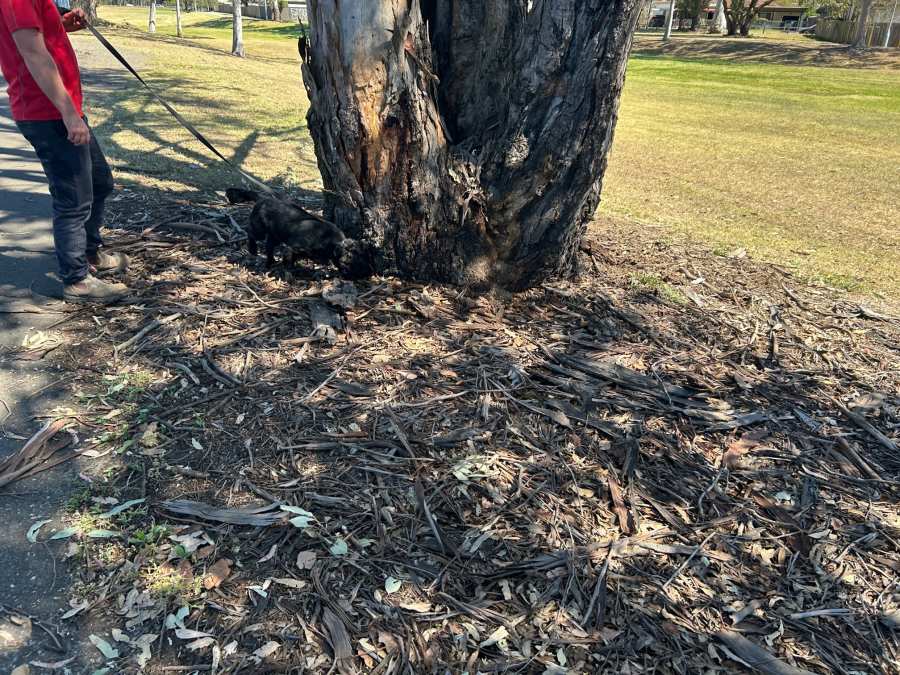
Trained detection dog inspecting building exterior for termite protection strata in a large apartment complex
Strata Bylaws, Liability and Budgeting for Long-Term Termite Management
Most strata schemes handle termite liability badly because the bylaws are silent on it. Termite management belongs in the building maintenance plan, with a line item in the capital works fund, not as a reactive expense after damage appears. Proactive oversight of the building envelope is essential to this strata building maintenance strategy, as compromised exterior coatings often provide the initial entry points for subterranean pests.
The Legal Distinction: Owners Corporation vs Individual Owner
The starting point is the statutory definition of common property under your state or territory’s strata legislation. Broadly, the owners corporation maintains and repairs common property, while the lot owner is responsible for everything inside the lot. The termite barrier, slab edge, weep holes, subfloor and roof void almost always sit on common property, so the owners corporation carries the prevention obligation, even though damage often shows up inside a private lot.
Drafting a Termite Bylaw That Actually Works
A termite bylaw does not need to be long, but it needs to be specific. A workable clause typically does four things:
- Mandates a compliant termite management system maintained to AS 3660, with the owners corporation responsible for the common-property components.
- Sets a minimum inspection frequency, usually annual, with provision for six-monthly where risk factors exist.
- Requires records to be kept and made available to lot owners and prospective purchasers on request.
- Defines lot-owner obligations inside the lot, such as reporting moisture, not storing timber against shared walls, and allowing access for inspections.
Budgeting for Long-Term Termite Management
The capital works fund, sometimes called the sinking fund, is the correct home for termite management, not the administrative fund. Inspections, barrier servicing, reticulation recharges and eventual barrier replacement are capital in nature and should be forecast over a ten-year horizon in the scheme’s capital works plan.
|
Approach |
What It Involves |
Risk Profile |
|---|---|---|
|
Preventative program |
Scheduled inspections, barrier servicing, documented records |
Low, catches activity early, preserves warranty cover |
|
Reactive approach |
Treat only when damage is visible |
High, damage is usually advanced, repairs and legal disputes follow |
Insurance: What Is Actually Covered
Building insurance typically excludes gradual damage from termites, borers and other pests, covering sudden events, fire, storm, impact, not timber consumed slowly over years. That exclusion is the strongest argument for funding prevention from the capital works fund rather than relying on a claim.
Making It Stick
Three things fix the liability and budgeting problem:
- Add a bylaw clause requiring the owners corporation to maintain a compliant termite management system and keep inspection records.
- Budget annually in the capital works fund for inspections, barrier servicing, and a contingency for remediation, so a finding never forces a special levy at short notice.
- Define responsibility between common property and lot property in writing, so owners know what they must do inside their own unit and what the owners corporation must do outside it.
Done properly, this turns termite management from a recurring dispute into a routine line item, which is exactly what it should be.
Conclusion: Building a Termite Protection Plan for Your Strata Scheme
Every strata scheme has a termite risk profile, documented or not. The schemes that avoid expensive damage treat termite protection strata management as routine maintenance: a compliant barrier, a documented inspection schedule, and a funded budget.
Frequently Asked Questions
How do I protect wooden structures in a strata scheme from termites?
Protection combines several layers. Keep AS 3660 compliant barriers intact, manage moisture around slab edges and weep holes, seal gaps with polyurethane sealant, and schedule regular professional inspections. For active threats, systems such as Sentricon target the termite colony directly. Termite protection for strata works best as an ongoing program rather than a one-off treatment, because subterranean termites can travel from common property into individual lots through timber framing and concealed voids.
What is the Australian Standard for termite protection?
AS 3660 is the Australian Standard covering termite management for new and existing buildings. It sets out requirements for physical and chemical barriers, inspection access, documentation and ongoing maintenance. Compliance matters for strata schemes because owners corporations must demonstrate that reasonable steps have been taken to protect common property. A pest inspection report referencing AS 3660 also supports insurance and warranty claims if termite damage is later discovered in timber framing or other structural elements.
How often should strata properties undergo termite inspections?
Most strata schemes should arrange a professional inspection at least once a year, with six-monthly checks for buildings in known termite-prone areas or where previous activity has been recorded. Strata termite inspection frequency also depends on barrier type, landscaping, drainage and the building’s construction. Annual audits keep the owners corporation compliant, feed into the building maintenance fund, and catch early signs such as mud tubes, hollow timber or moisture build-up before remediation costs escalate.
Why are termite detection dogs more effective for large strata complexes?
Termite detection dog accuracy in controlled environments exceeds 95%. For large strata complexes, dogs cover more ground in less time, checking multiple units, common property and concealed areas in a single visit. This speed and precision improve early detection, when treatment is less disruptive and less costly, and it gives the owners corporation clearer evidence for compliance records and long-term planning.
How do physical and chemical termite barriers differ for wooden structures?
Physical termite management systems use materials such as graded stone or stainless steel mesh to block termites from reaching timber. Chemical soil treatment creates a treated zone around the building, and reticulation systems allow top-ups without excavation. Physical barriers last longer but can be disturbed by landscaping, while chemical barriers need replenishment. Many strata buildings combine both, and AS 3660 compliance depends on whichever barrier is installed being inspected and maintained correctly.
What should be included in a strata termite management plan?
A workable plan lists the barrier type and location, inspection schedule, responsible parties, record-keeping process and budget allocation from the building maintenance fund. It should also cover moisture control, weep holes, slab edges and any timber framing details, plus a process for reporting activity to lot owners. Integrating these requirements into strata bylaws clarifies obligations for owners and the committee, supports liability management, and makes annual audits straightforward to complete.