

Table of Contents
- What Pet Safe Pest Control for Homes Actually Means
- Eco-Friendly Pest Control Methods That Work
- Pest Control Safety for Dogs and Cats: What to Know Before Treatment
- How Long Should Pets Stay Away After Pest Control?
- Preparing Your Home Before and After a Pet Safe Pest Control Visit
- Emergency Response: If Your Pet Is Exposed to Pesticides
- Choosing a Provider: Ingredient Transparency and Questions to Ask
- Frequently Asked Questions
Last Updated: September 28, 2026
What Pet Safe Pest Control for Homes Actually Means
Pet safe pest control for homes means managing infestations with products and methods chosen so cats, dogs and other companion animals are not harmed when used correctly. At Redback Pest Control Sydney, we treat it as a set of decisions rather than a single product: which active ingredient, where it is placed, how it is applied, and how long pets stay clear.
Eco-Friendly Pest Control Methods That Work
Eco-friendly pest control methods remove the conditions pests need, then use the least toxic effective treatment for whatever remains. This approach, integrated pest management (IPM), prioritises prevention over spraying and treats chemical use as a last resort. Refining these strategies often involves incorporating natural pest control methods to maintain a secure environment for your animals.
A practical sequence for most homes:
- Exclusion – seal gaps under doors, repair torn fly screens, and block weep holes with purpose-made mesh. This alone can eliminate entry points for rodents, cockroaches and spiders.
- Sanitation – clear food scraps, fix dripping taps, and store pet food in sealed containers. Pet food left out overnight is one of the most common attractants for ants and rodents.
- Habitat reduction – remove leaf litter, timber offcuts and standing water near the house. These are harbourage and breeding sites for mosquitoes, termites and spiders.
- Traps and bait stations – place enclosed stations where pets and children cannot reach them. Tamper-resistant stations are the only safe way to use rodenticide in a home with pets.
- Targeted low-toxicity treatment – apply only where monitoring shows activity, not as a blanket spray.
Low-Toxicity Treatments and Natural Repellents
Natural repellents such as diatomaceous earth, horticultural oils and insecticidal soaps handle small, localised problems well. They are contact treatments that break down quickly and leave little residue, but need frequent reapplication and rarely solve a settled infestation.
Ingredient Transparency: What to Look For on a Label
Most pet owners cannot tell a safe product from a risky one because they do not know which active ingredients to watch for. A transparency checklist:
- Pyrethrins and pyrethroids – effective against many insects but highly toxic to cats and fish. Avoid permethrin-based products in homes with cats.
- Organophosphates – nervous system effects in mammals; rarely used domestically now, but still worth checking for on older stock.
- Anticoagulant rodenticides – cause internal bleeding; only safe when enclosed in tamper-resistant stations.
- Insect growth regulators (IGRs) – low vertebrate toxicity; they disrupt insect development rather than killing on contact.
- Diatomaceous earth – mechanical action; low mammalian toxicity but a respiratory irritant in dust form.
Pest Control Safety for Dogs and Cats: What to Know Before Treatment
Pest control safety for dogs and cats comes down to three variables: the active ingredient, the concentration, and the route of exposure. Cats are generally more vulnerable than dogs because they groom constantly and their liver processes many chemicals differently. Birds and reptiles are even more sensitive to airborne compounds and residues, so space treatments and fogging require extra caution around them.
Species-Specific Toxicity: Dogs, Cats, Birds and Reptiles
Pyrethroids are the classic species gap. Permethrin is tolerated by most dogs at label rates but is highly toxic to cats, which is why many spot-on dog treatments carry an explicit cat warning. Birds are highly sensitive to pyrethrin sprays and aerosols, and reptiles absorb residues through their skin. Rodenticides are the other major risk: most act as anticoagulants, and a dog that eats a poisoned rodent or the bait can bleed internally.
|
Active Ingredient |
Main Risk to Pets |
Practical Safeguard |
|---|---|---|
|
Pyrethroids (e.g. permethrin) |
Severe toxicity in cats; respiratory risk in birds |
Keep cats and birds away from dog-only products |
|
Anticoagulant rodenticides |
Bleeding after bait ingestion |
Tamper-resistant bait stations only |
|
Organophosphates |
Nervous system effects |
Rarely used domestically; avoid where pets roam |
|
Insect growth regulators |
Low vertebrate toxicity |
Still keep pets off treated surfaces until dry |
|
Diatomaceous earth |
Eye and respiratory irritation |
Apply thinly; keep pets clear of dust |
|
Essential oil repellents (e.g. tea tree, eucalyptus) |
Toxicity in cats and birds; skin irritation |
Avoid diffusers and sprays near cats and birds |
Emergency Response: If Your Pet Is Exposed to Pesticides
If you suspect exposure, call your vet or a poisons information service immediately and have the product name and active ingredient ready. Do not wait for symptoms, and do not induce vomiting unless a vet tells you to.
A simple emergency checklist:
- Identify the product and active ingredient
- Note the time of exposure and the route (skin, ingestion, inhalation)
- Call your vet or the Poisons Information Centre immediately
- Do not induce vomiting unless instructed
- Bring the container or label to the vet
- Keep the pet calm and warm while waiting for advice
Questions to Ask Before You Book
A provider worth hiring will tell you the active ingredient, the concentration and the re-entry time before you book. If a quote does not include those details, that is the answer you need.
- Will you name the active ingredient and its concentration?
- What is the re-entry time, and does it change for cats, birds or reptiles?
- Where exactly will bait and gel be placed?
- Are you licensed, and is the work covered by a warranty?
- What happens if the problem returns?
How Long Should Pets Stay Away After Pest Control?
The usual answer is until all treated surfaces are completely dry, typically two to four hours for internal sprays and longer in humid or poorly ventilated rooms. That is a general rule, not a fixed number: the product label is the authority, and your technician should tell you the specific re-entry time before they pack up.
Preparing Your Home Before and After a Pet Safe Pest Control Visit
Preparation makes a pet safe pest control visit quick and low-stress. Before the technician arrives, clear floors and benches, move pet bowls and bedding out of the treatment zone, and confine animals to a room that will not be treated.
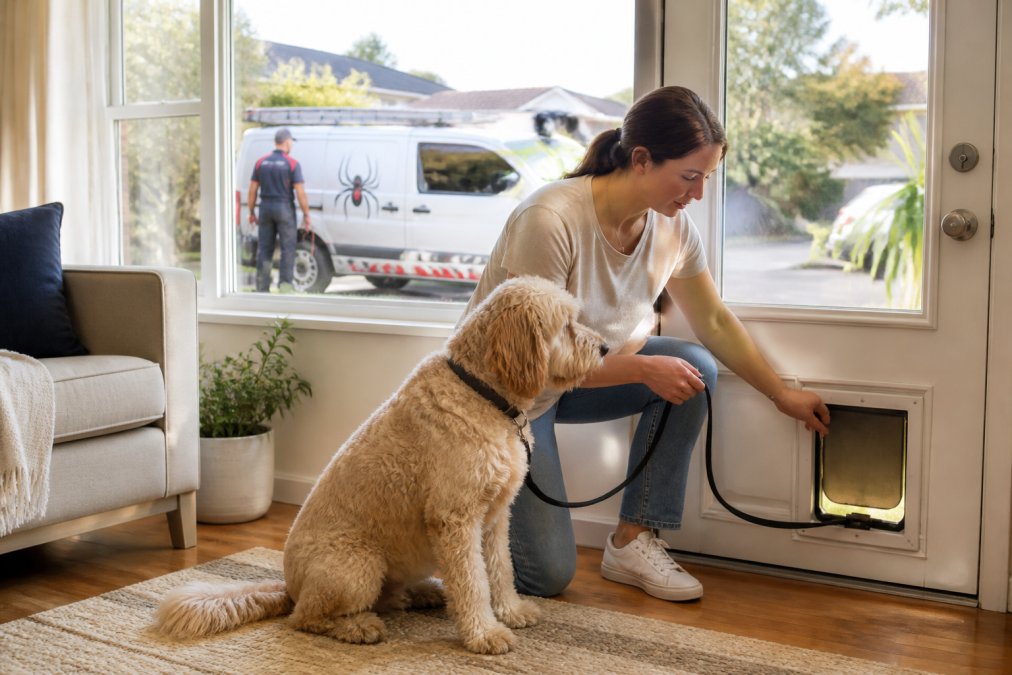
A simple before-and-after checklist:
- Confine pets to an untreated room or arrange a day out
- Remove pet food, water bowls and bedding
- Clear floors, benches and under-sink areas
- Cover fish tanks and turn off aerators
- Ventilate for at least the stated re-entry period
- Wash exposed food surfaces and pet bowls
- Confirm bait station placement with the technician
Emergency Response: If Your Pet Is Exposed to Pesticides
If you suspect exposure, call your vet or a poisons information service immediately and have the product name and active ingredient ready. Do not wait for symptoms, and do not induce vomiting unless a vet tells you to.
Choosing a Provider: Ingredient Transparency and Questions to Ask
A provider worth hiring will tell you the active ingredient, the concentration and the re-entry time before you book. If a quote does not include those details, that is the answer you need.
An ingredient transparency checklist worth running through:
- Will you name the active ingredient and its concentration?
- What is the re-entry time, and does it change for cats?
- Where exactly will bait and gel be placed?
- Are you licensed, and is the work covered by a warranty?
- What happens if the problem returns?
Frequently Asked Questions
What is the best pest control safe for pets?
There is no single ‘best’ option, but pet safe pest control for homes usually relies on targeted methods rather than broad spraying. Baits in sealed stations, gels, traps and low-toxicity products reduce the chance of dogs and cats contacting active ingredients. Ask the provider for the Safety Data Sheet and confirm the product’s re-entry period before booking, since the right choice depends on the pest, the treatment area and your pet’s habits.
How long should pets stay away after pest control?
Re-entry times vary by product and application method. Many surface sprays require pets to stay off treated areas until dry, which is often a few hours, while some residual treatments and fogging may need 24 hours or more. The technician should give you a written re-entry period for each product used. Always follow that advice rather than a generic rule, and keep pets away longer if they lick surfaces or chew plants.
What precautions should I take before a pest control visit?
Remove pet food and water bowls, cover fish tanks and turn off their filters, put away chew toys and bedding, and secure birds and reptiles in a separate room. Clear access to skirting boards, cupboards and treatment zones. Tell the technician about any pregnant, elderly or unwell pets, and ask which active ingredients will be used so you can check them against your pet’s known sensitivities.
Are eco-friendly pest control methods really effective?
Eco-friendly pest control methods such as integrated pest management, sealing entry points, removing food and water sources, and using targeted low-toxicity products can manage many household pests well when applied consistently. They often need more monitoring than a single chemical spray, but combining prevention with professional treatment reduces chemical exposure for pets while still controlling ants, cockroaches and rodents.
Pest problems rarely wait for a convenient moment, and the wrong treatment can put a pet at risk. Redback Pest Control Sydney brings over 30 years of experience, a family-safe guarantee, and specialised termite dog inspections to every job, backed by the Sentricon® system for termite protection. Get a free quote and book a treatment plan built around your household, pets included.