
Table of Contents
- What Fast and Reliable Pest Control Actually Delivers
- Quick Comparison: Options for Pest Infestation Removal
- Redback Pest Control Sydney: Verdict and Review
- Safe Pest Control for Pets and Children
- How to Identify Early Signs of Termite Infestation
- Professional Pest Control Treatment Duration
- Frequently Asked Questions
Last Updated: October 2, 2026
What Fast and Reliable Pest Control Actually Delivers
Fast and reliable pest control is a service that identifies an active infestation, treats it at the source, and prevents it from returning, all within a timeframe that limits damage to your property. For most households and businesses, the real value is not the spray itself but the speed of diagnosis and the follow-up that stops the problem recurring.
Quick Comparison: Options for Pest Infestation Removal
Professional baiting and monitoring systems deliver the most reliable long-term results for established infestations, while retail sprays and ultrasonic devices suit minor, isolated problems only. The table below summarises how each option performs.
|
Option |
Best For |
Speed |
Long-Term Reliability |
|---|---|---|---|
|
Professional pest control |
Established infestations, termites, rodents |
Fast response |
High, with monitoring |
|
Retail sprays and baits |
Minor, isolated sightings |
Immediate |
Low |
|
Ultrasonic devices |
Passive rodent deterrence |
Slow |
Limited |
|
Natural and organic products |
Gardens, minor indoor pests |
Moderate |
Requires re-application |
|
Termite baiting systems |
Structural termite protection |
Staged |
Very high |
How We Evaluated These Options
We judged each option on four criteria: how quickly it resolves an active infestation, how well it prevents recurrence, how safe it is around children and pets, and whether the cost reflects the outcome. A cheap treatment that fails twice is more expensive than one that works.
Redback Pest Control Sydney: Verdict and Review
Redback Pest Control Sydney is our top pick for fast, reliable pest infestation removal because it combines three decades of local experience with detection and treatment methods most operators do not offer. The team services homes, businesses and government facilities across the metropolitan area and Western Sydney.
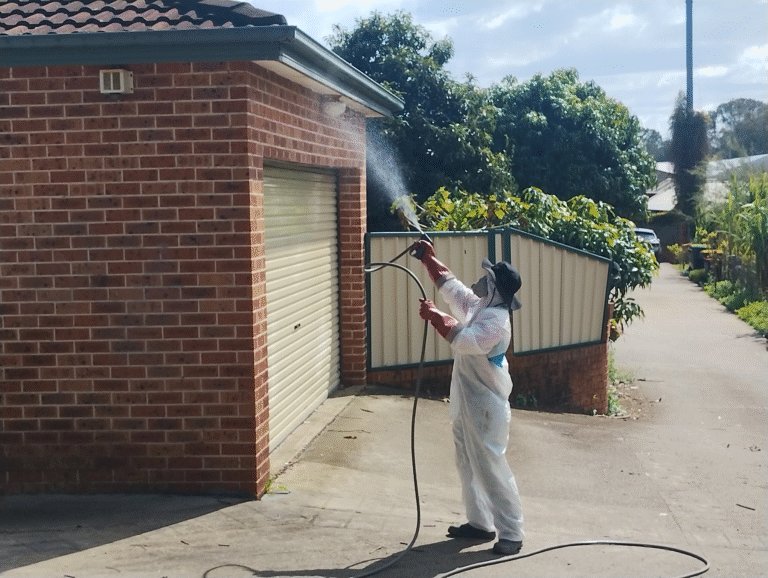
Pest control technician in hi-vis uniform inspecting suburban brickwork at dusk with a torch and clipboard
Strengths and Limitations
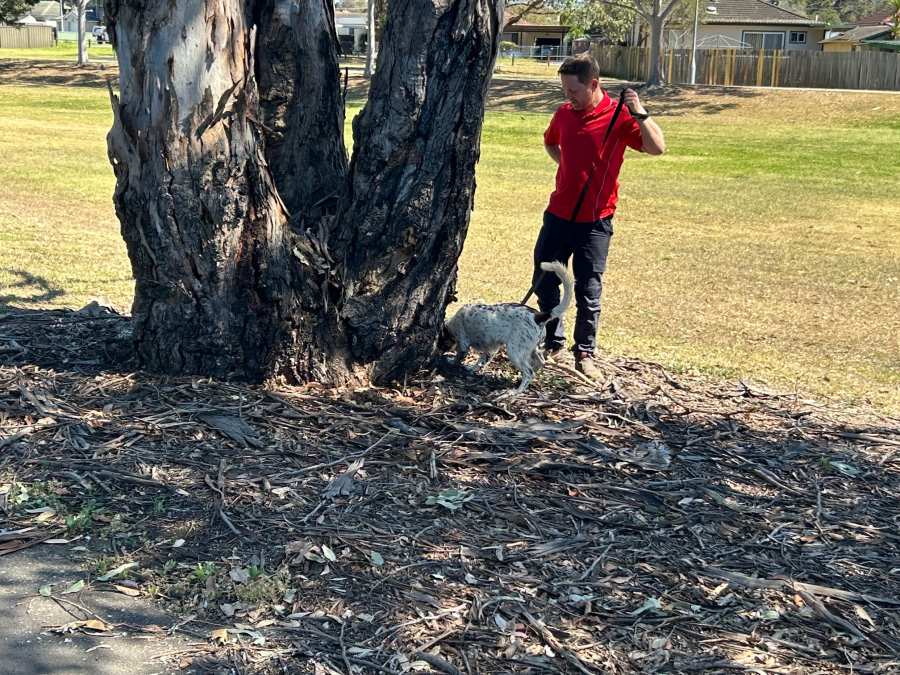
The strengths are clear: a family-safe guarantee, specialised termite dog inspections, the Sentricon® system for structural protection, and coverage for both residential and commercial sites. Property managers with multiple sites can arrange scheduled maintenance rather than one-off visits. It is also worth checking the current Special Offers before booking, as these can make professional treatment more accessible.
Safe Pest Control for Pets and Children
Safe pest control for pets and children is less about avoiding treatment and more about matching the formulation, the dose and the placement to the household. Two properties can receive the same active ingredient and carry very different risk profiles depending on whether it was applied as a surface spray across a skirting line or as a contained gel inside a wall void.
How the main treatment classes differ
- Non-repellent residual sprays are applied to cracks, voids, skirting lines and exterior perimeters. They bind to the surface and remain active for weeks to months. The risk is not the dried residue in a living area; it is contact during application and before the surface cures.
- Gels and baits are placed inside harbourage points, wall voids, behind appliances, in bait stations. Because the active ingredient is contained and consumed rather than sprayed, exposure to children and pets is minimal when stations are locked and correctly sited.
- Dusts are blown into wall cavities and roof voids. They are effective in concealed spaces but should never be applied where they can drift into living areas.
- Non-chemical methods, heat treatment, vacuuming, physical removal, exclusion work such as sealing entry points, carry no residue at all. They are slower and often need to be combined with a chemical approach for established infestations, but they are the preferred first line in nurseries, food preparation areas and homes with infants.
Re-entry and the curing window
The single most useful piece of information a technician can give you is the re-entry time. For most internal residual treatments, surfaces are considered safe once dry, which is typically a matter of hours rather than days. External perimeter treatments usually carry no indoor re-entry restriction at all. Bait stations and gels have no curing window because nothing is applied to an open surface.
- Keep children and pets out of treated rooms until surfaces are dry, not just until the technician leaves
- Ask which product class is being used and where it will be placed
- Confirm re-entry times in writing on the treatment record
- Never transfer leftover retail product into unlabelled containers, and store anything remaining locked away from children
- Tell the technician about fish tanks, bird cages and reptiles before work begins, some treatments require them to be covered or moved
What to ask before you book
A short list of questions separates a provider who understands household safety from one who does not:
- Which product class will you use, and why that one for this pest?
- Where exactly will it be applied, and will any of it be in rooms we use daily?
- What is the re-entry time, and does it differ for pets versus children?
- Are there pets, fish or birds on the property you need to account for?
- What is the follow-up, and will the same products be used again?
How to Identify Early Signs of Termite Infestation
Early signs of termite infestation include mud tubes on foundations, hollow-sounding timber, bubbling or blistered paint, and discarded wings near windows. Catching these signs early is the difference between a targeted treatment and major structural repair, but the signs themselves are only useful if you understand what produces them.
What each sign actually means
- Mud tubes are shelter tunnels built by subterranean termites to move between soil and timber while staying out of the open air. They are usually found on foundations, piers, retaining walls and the underside of suspended floors. A fresh tube is damp and dark; an old one crumbles.
- Hollow-sounding timber is the result of termites eating the soft grain and leaving a thin veneer. Tap along skirting boards, door frames and architraves with the handle of a screwdriver and listen for a change in tone.
- Bubbling or blistered paint happens when moisture from termite activity pushes the paint film away from the timber. It is easy to mistake for water damage, which is why the next step is to probe rather than repaint.
- Discarded wings near windows and doors are the leftovers from a swarm. Reproductives shed their wings after mating flights, usually in warmer months after rain. Finding a scatter of identical wings is a strong signal that a colony is nearby.
- Sagging floors or doors that suddenly stick indicate that structural timber has lost mass. By this stage the infestation is usually well established.
Why visual inspection has limits
A competent visual inspection covers the accessible parts of the property: subfloor, roof void, exterior perimeter, interior walls where inspection ports exist, and the immediate surrounds. What it cannot do is see inside a rendered wall, behind a tiled bathroom, under a concrete slab or inside a sealed cavity.
A practical early-detection routine
You do not need to be an inspector to catch a problem early. A short routine every few months covers most of what a homeowner can reasonably check:
- Walk the exterior perimeter and look for mud tubes on foundations, piers and retaining walls.
- Check where timber meets soil, garden sleepers, fence posts, decking bearers, for signs of tunnelling.
- Tap skirting boards and door frames in rooms with timber floors and listen for hollow sections.
- Look for bubbling paint or unexplained moisture stains on walls and ceilings.
- Check window sills and light fittings for discarded wings after warm, humid weather.
- Keep the subfloor dry and well ventilated, and remove timber offcuts and stored cardboard from against the house.
Professional Pest Control Treatment Duration
Most professional pest control treatments take between one and three hours on site, with termite baiting and monitoring programs continuing over weeks or months. The duration depends on the pest, the size of the property and the method used.
- Single-visit treatments: ants, cockroaches, spiders
- Two-visit programs: active rodent infestations
- Ongoing monitoring: termite baiting systems
Frequently Asked Questions
What should I look for when hiring a professional pest control service?
Check for a current pest management licence, public liability insurance and a written warranty before booking. Ask which pests the technician is licensed to treat, whether follow-up visits are included, and how the company handles a call-back if activity continues. A reliable provider will give you a clear written scope, a treatment plan tailored to your property, and a warranty that states exactly what is covered and for how long. Vague answers or pressure to sign on the spot are warning signs worth walking away from.
How quickly can professional pest control remove an infestation?
Most established infestations need more than a single visit. Cockroaches and ants often drop sharply within days of a targeted treatment, while rodents usually take one to three weeks as bait is taken and the population declines. Termite colonies are slower again, because baiting systems rely on termites carrying the active ingredient back to the nest. Your technician should give you a realistic timeline in writing, along with the signs that show the treatment is working.
Are professional pest control treatments safe for pets and children?
Registered products are applied at low concentrations and, once dry, are generally safe around pets and children. The main precaution is keeping everyone clear of treated surfaces during application and while they dry, which is usually a few hours. Tell your technician about pets, young children, asthma or allergies so they can choose the least disruptive option and site baits away from curious hands and paws. Ask for the product name and label directions if you want to check the details yourself.
What is the difference between DIY pest control and professional services?
Hardware store baits and sprays handle small, isolated problems and cost very little. They struggle with established infestations, because the nest or colony usually sits somewhere you cannot reach, and repeated spraying can scatter insects rather than eliminate them. Professional services bring licensed technicians, pest identification, and products that are not sold at retail. For termites in particular, DIY options do not offer the colony-level control or the warranty that a monitored baiting system provides.
How long does professional pest control treatment last?
It depends on the pest and the treatment. General pest treatments often stay effective for around six to twelve months, which is why annual maintenance visits are common. Termite baiting systems need ongoing monitoring because the stations must be checked and refreshed. Rodent programs usually run for several weeks until activity stops. Ask what the warranty period is, what triggers a free call-back, and when your next inspection is due so you are not relying on guesswork.
Pest infestations rarely resolve on their own, and the cost of delay is measured in damaged timber and repeat treatments. Redback Pest Control Sydney offers over 30 years of experience, a family-safe guarantee, specialised termite dog inspections and the Sentricon® system for lasting structural protection. Get a free quote from Redback Pest Control Sydney and secure a pest-free environment for your property.