
Table of Contents
- Why Termite Baiting Systems Are the Smart Choice for Australian Homes
- Quick Comparison: 5 Best Termite Baiting Systems
- 1. Sentricon AlwaysActive: Best for Set-and-Forget Protection
- 2. Exterra Termite Interception System: Best Australian-Made Option
- 3. Trelona Advance: Best for Fast-Acting Colony Elimination
- 4. Advance Termite Bait System: Best for DIY Monitoring
- 5. Redback Pest Control Sydney: Best Professional Installation and Monitoring
- Termite Baiting vs Chemical Barrier: Which Protects Your Home Better?
- Frequently Asked Questions
Last Updated: October 2, 2026
Why Termite Baiting Systems Are the Smart Choice for Australian Homes
Termite baiting is a colony-elimination strategy that places monitored stations containing cellulose-based bait around a home’s perimeter, letting foraging termites carry a slow-acting growth regulator back to the nest. This guide from Redback Pest Control Sydney compares five systems, and it matters because baiting targets the colony itself rather than only blocking the termites you can see.
Most homeowners only discover termites when damage is already done. Baiting works differently: it exploits termite foraging behaviour, so the colony destroys itself from the inside. Below, we break down the five best termite baiting systems for residential homes, what each costs in maintenance effort, and where each one falls short.
Baiting eliminates colonies. Barriers block termites. If you want the nest gone rather than just redirected, baiting is the strategy that does it.
Quick Comparison: 5 Best Termite Baiting Systems
Here is how the five systems stack up on the specifications that actually determine whether baiting works in a residential setting: the bait active ingredient, how termites find the station, the monitoring interval the system depends on, and how long the hardware is expected to last in the ground.
| System | Bait active ingredient | How termites find it | Monitoring interval | Station longevity | Best for |
|---|---|---|---|---|---|
| Sentricon AlwaysActive | Noviflumuron (chitin synthesis inhibitor) | Recruit HD cellulose matrix, attractive on day one | Professional service visits, typically quarterly to annual | In-ground stations rated for many years; lids and cartridges replaced as needed | Set-and-forget protection |
| Exterra | Hexaflumuron in Requiem bait | Focus termite attractant primes the station | Regular professional service | Durable in-ground stations with replaceable bait cartridges | Compliant long-term cover |
| Trelona Advance | Novaluron in compressed cellulose bait | Highly palatable compressed matrix | Service agreement with scheduled checks | Compressed bait holds up across varied soil types | Fast colony elimination |
| Advance TBS | Diflubenzuron (bait added after activity is confirmed) | Monitoring cartridge first, bait second | Homeowner-led, ideally checked monthly | Stations reusable; cartridges and bait replaced over time | Monitoring-first budgets |
| Redback Pest Control Sydney | Sentricon AlwaysActive bait, professionally managed | Recruit HD matrix plus dog-assisted detection | Scheduled service visits | Stations maintained and replaced as part of the service | Full-service peace of mind |
What the table does not tell you
Two things matter more than the brand name. First, monitoring cadence: a station that is not checked is a plastic tube in the ground. Termites can forage past an empty or expired station for months without triggering anything, which is why every professional system here is built around a service schedule rather than a one-off install.
Long-term maintenance reality
A common pattern across all five systems is that the upfront hardware is the cheap part and the ongoing monitoring is the real commitment. Over a five-year horizon, a professionally managed system typically involves multiple service visits per year, bait replacement when activity is detected, and occasional station or lid replacement after landscaping work, mowing damage, or soil movement.
Baiting is a monitoring system first and a poison second. The bait only works if someone is checking the station often enough to notice when termites arrive.
1. Sentricon AlwaysActive: Best for Set-and-Forget Protection
Sentricon AlwaysActive is the top pick for homeowners who want termite baiting handled entirely by professionals. It uses Recruit HD bait, which is immediately available to termites the moment stations go in the ground, so there is no waiting period for the bait to become attractive.
Key Features and How It Works
The system is built for long-term colony elimination rather than simple repellence. Certified technicians install and monitor the stations, and the low-profile design sits neatly within garden beds and along the perimeter. Because it is a professional service, you are not responsible for checking bait consumption or replacing cartridges.
Pros and Cons
Pros: strong colony elimination, minimal disruption to landscaping, no DIY monitoring burden.
Cons: requires professional installation and an ongoing service contract, so it is not a one-off purchase.
2. Exterra Termite Interception System: Best Australian-Made Option
Exterra is an Australian-recognised system that intercepts termites in the soil before they reach the structure. It uses Requiem bait plus a termite attractant called Focus, which increases how quickly termites find the stations.
Key Features and How It Works
Stations are placed in the soil around the home, where foraging termites encounter them and carry bait back to the colony. The system is designed to comply with Australian Standards for termite management, which matters if you need documented protection for a property transaction.
Pros and Cons
Pros: highly effective at colony elimination, well established locally, compliant documentation.
Cons: higher initial setup cost than DIY monitoring kits.
3. Trelona Advance: Best for Fast-Acting Colony Elimination
Trelona Advance suits homeowners who want results quickly. It uses Trelona Compressed Termite Bait, a highly palatable bait matrix designed to be taken up fast, and it performs reliably across varied soil conditions.
Key Features and How It Works
In-ground monitoring stations hold the compressed bait, and regular professional inspections keep the system active. The bait matrix is engineered for durability, so it holds up in different soil types rather than degrading before termites find it.
Pros and Cons
Pros: fast-acting bait technology, dependable across environments.
Cons: not sold for direct consumer use, so professional application is required.
4. Advance Termite Bait System: Best for DIY Monitoring
Advance TBS is the pick for homeowners who want to monitor first and bait later. Starter kits generally sit in the $150 to $200 range, making it the most affordable entry point on this list.
Key Features and How It Works
Each station holds an inspection cartridge for early detection. Once termite activity is confirmed, you add bait to the same station. The catch is diligence: you must check stations on a consistent schedule, or the system quietly stops working.
Pros and Cons
Pros: proactive monitoring, low upfront cost.
Cons: effectiveness depends entirely on your own inspection routine.
5. Redback Pest Control Sydney: Best Professional Installation and Monitoring
Redback Pest Control Sydney is our top recommendation for homeowners who want the whole job handled. With over 30 years of experience, the team installs and maintains the Sentricon system and backs it with specialised termite dog inspections, which can pinpoint activity that visual checks miss.
Key Features and How It Works
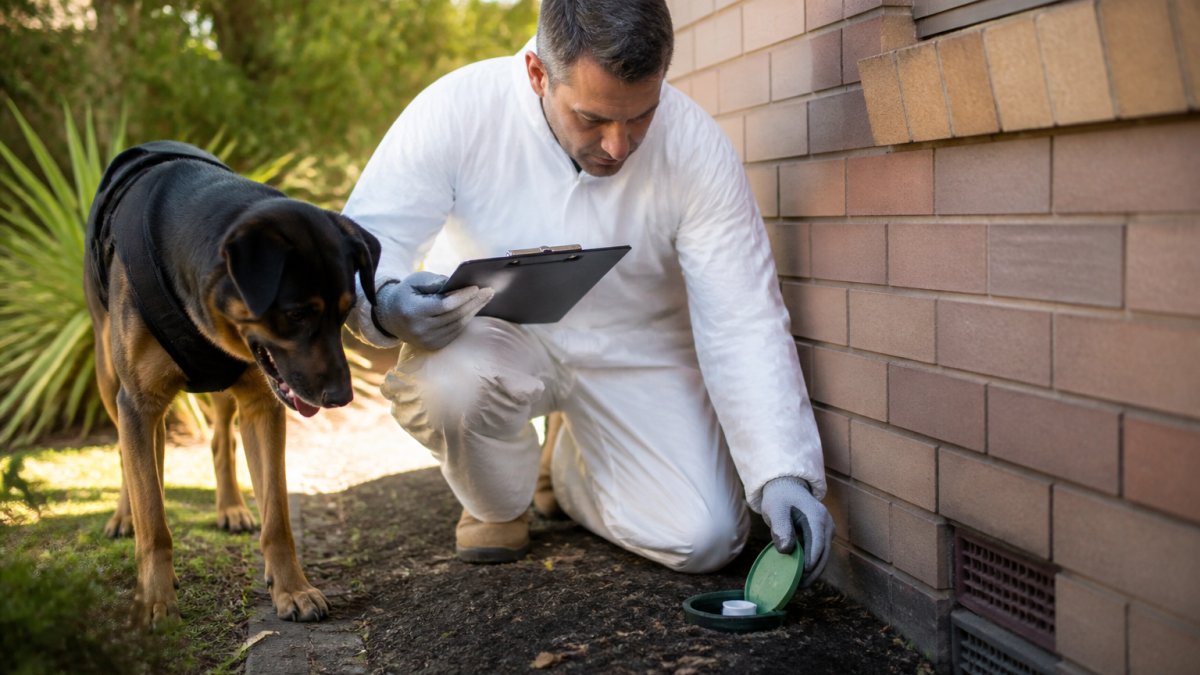
A trained termite detection dog, Andy, screens for concealed activity before and after treatment, while Sentricon stations provide continuous colony elimination. The service covers homes and businesses, with a family-safe approach and a pest control warranty for peace of mind. You can view current options on the special offers page or explore termite control services.
Pros and Cons
Pros: 30-plus years of experience, dog-assisted detection, Sentricon protection, family-safe guarantee.
Cons: a managed service rather than a DIY kit, so it suits homeowners who prefer not to monitor stations themselves.
Termite Baiting vs Chemical Barrier: Which Protects Your Home Better?
Baiting and chemical barriers solve different problems, and the right answer for most homes is not one or the other, it is knowing which job each one does.
A chemical soil barrier is a treated zone applied to the soil around and under a home, designed to stop termites crossing undetected.
A baiting system is an active strategy.
How each is installed in a residential setting
A chemical barrier typically involves trenching or drilling along the perimeter, injecting termiticide into the soil, and reinstating the surface.
Baiting installation is lighter: stations are set into the soil at intervals around the home, usually in garden beds, along fence lines, and at known termite entry points.
What to do when baiting fails
This is the part most guides skip. Termites bypassing stations, ignoring bait, or appearing inside the home despite an active system is a real and reasonably common scenario. The usual causes are:
- Stations in the wrong place. Termites follow moisture and timber edges, not neat geometric spacing. If stations are sitting in dry, compacted, or regularly disturbed soil, foraging termites may never encounter them.
- Bait that is no longer attractive. Cellulose bait can degrade, absorb moisture, or be consumed without replacement. An empty station is not a working station.
- A competing food source. Untreated timber, stored firewood, garden sleepers, or a previous infestation left in place can out-compete the bait.
- A separate colony. Eliminating one colony does not protect against a neighbouring nest foraging into the same yard.
- Monitoring gaps. The single most common cause. A station left unchecked for months can sit empty while termites forage straight past it.
When baiting appears to have failed, the practical response is to re-inspect station placement against actual termite activity, refresh or replace bait, remove competing timber and moisture sources, and consider pairing baiting with a chemical barrier so the home has both an active colony-elimination strategy and a passive perimeter defence.
Australian Standards and documentation
Termite management around homes is covered by the AS 3660 series of Australian Standards, which sets out how systems are installed, how they are inspected, and what documentation should be kept. This matters at two points: when a system is installed, and when a property is sold or bought.
Skipping monitoring intervals is the most common reason baiting fails. A station left unchecked for months can sit empty while termites forage past it, wasting the entire installation.
Frequently Asked Questions
Which termite baiting system is best rated for residential use?
Sentricon AlwaysActive and Exterra consistently rank highest for residential properties. Sentricon uses Recruit HD bait that is immediately available to termites upon installation, making it effective for ongoing colony elimination. Exterra is Australian-made and compliant with local standards, using Requiem bait and a Focus attractant to increase station discovery. Both require professional installation and regular monitoring, which is why they perform better than DIY alternatives in long-term protection.
Do termite baiting systems really work to eliminate colonies?
Yes, when installed and maintained correctly. Baiting systems use slow-acting toxins or growth regulators that termites carry back to the colony, eventually eliminating the queen and the broader population. Unlike chemical barriers that repel termites, baiting targets the colony directly. The key is regular monitoring and replenishing bait as needed. Systems like Trelona Advance offer faster results, while others may take several months to achieve full colony elimination.
What is the difference between termite baiting and chemical barriers?
Termite baiting uses stations placed in the soil that contain cellulose-based bait mixed with slow-acting toxins. Termites forage into the stations, consume the bait, and transfer it back to the colony. Chemical barriers, by contrast, create a treated zone in the soil that termites cannot pass through or that kills them on contact. Baiting eliminates the colony over time, while barriers provide immediate exclusion. Many homeowners combine both for comprehensive protection.
How often should termite baiting stations be inspected?
Most manufacturers recommend inspections every three to six months, depending on the system and local termite pressure. During inspections, technicians check for bait consumption, termite activity indicators, and station integrity. If termites are found, bait is replenished and monitoring frequency may increase. Skipping inspections allows stations to run out of bait or become blocked, which reduces effectiveness. Professional monitoring services typically include scheduled visits as part of the service agreement.
Are termite baiting systems safe for homes with pets and children?
Yes. Baiting systems are designed to be low-impact and family-safe. The bait stations are sealed and placed in the ground, so pets and children cannot easily access the active ingredient. The toxins used are targeted specifically at termites and are contained within the station. Professional installation ensures stations are placed correctly and tamper-resistant. If you have concerns, ask your pest management professional about the specific active ingredients and safety data for the system they recommend.